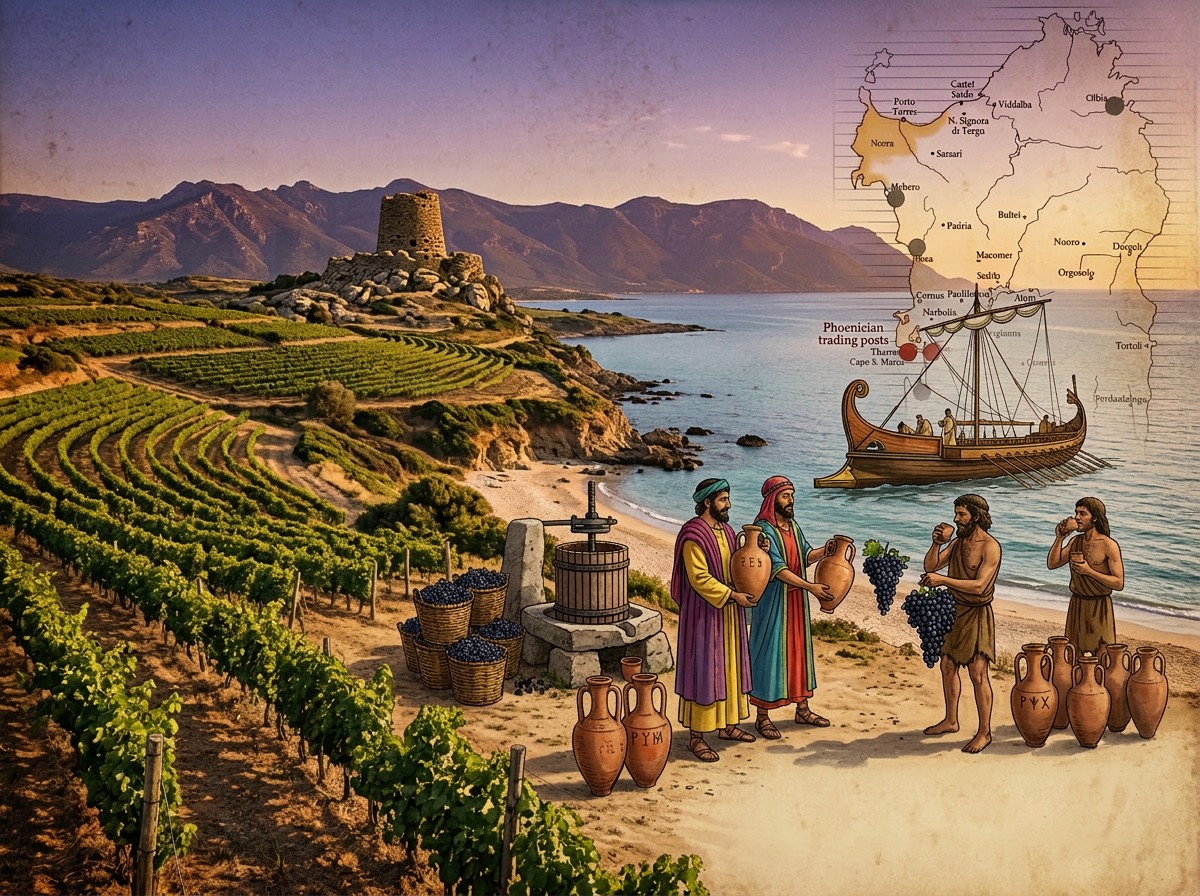
Abstract (IT): A trip to the Nurra three thousand years ago, when the sea was a highway crossed by the Phoenicians and the island did not receive viticulture but found an extraordinary commercial synthesis with the already flourishing Nuragic Civilization. From the archaeological discoveries of the site of Sant'Imbenia and the 3D analysis of carbonized vinaccioli, to the export of the fine Sardinian wine as luxury good in the ancient Mediterranean.
Abstract: A journey into the Nurra region 3,000 years ago, when the sea was a bustling highway for the Phoenicians, and the island did not learn winemaking from them but instead formed an extraordinary commercial partnership with the already flourishing Nuragic Civilization. From the archaeological discoveries at Sant'Imbenia and the 3D analysis of charred grape seeds, to the export of prized Sardinian wine as a luxury commodity across the ancient Mediterranean.
When we look at the sea of Sardinia, we tend to think it as a beautiful summer postcard. But three thousand years ago, that same sea was a real highway, crossed by the best navigators of ancient times: the Phoenicians.
For a long time we were told that they had brought us lives and taught us how to make wine. Actually, history is much more fascinating. When the Phoenicians they landed on the sardinian coasts, they found a Civilization Nuragic that wine produced it for centuries. What was born after was an extraordinary meeting of cultures, and the pulsating heart of this commercial revolution was precisely Nurra.
Saint Imbenia: Where the Phoenicians fell in love with Sardinian Wine
If there is a place that tells this story a stone's throw from Alghero, it is the ancient settlement of Saint Imbenia, in Nurra. Imagine this place around the 9th century BC: it was not a simple isolated village, but an international emporium where the nuragic community and Phoenician merchants lived and worked side by side.
Here the Phoenicians did not come to sell their products, but to buy the local ones. The NurraIn fact, it had become a very important production area. What exactly was the wine produced? The scientific investigations tell us that it was not a single generic grape, but a true primordial blend. To meet the birth of the Nurra wine were wild and domestic ancestors of our current vines, with a strong presence of white berry grapes — including the first ancestral forms of resistant and aromatic vines, similar to today's malvasia — and red berry varieties rich in color and structure.
In the warehouses of Sant'Imbenia were found the famous amphoras of levantina tradition. The incredible thing is that they were containers produced directly on the spot with mixed techniques, born to contain and make travel this special mix of Nurra towards the most important markets of the Mediterranean.
From Nurra to the World: The success of the Sardo product in the East
But how do we make sure this wine was so requested? Because archaeology has given us proof of the first, real commercial successes of Sardinia abroad.
The characteristics askoidi sardines, born for mescita during the ceremonial banquets, and the amphoras charged with the wine of Nurra were found in archaeological sites of half Europe. They are resurfaced by the excavations of Carthage, on the island of Crete and even in the ancient Spanish cities such as Cadiz, Huelva and Mozia. The wine produced in Sardinia was a real luxury, sought after by the aristocracies of the whole ancient Mediterranean.
How do you question a grape?
To reconstruct this dense network of exchanges and the antiquity of our vines, scientists had to literally make the past speak from tiny details: the vinaccioli, that is the small seeds of grapes, found carbonized on the bottom of the ancient amphoras.
The work behind it is fascinating. First, the land recovered from the excavation is immersed in water through a technique called flotation; the ancient semen, being carbonized, float lightly separating from the stones and are recovered intact. Then, thanks to digital morphometry, special software scans 3D vinaccioli under the microscope, measuring the shape and length of the "beak" to understand whether it is wild or already cultivated. Finally, in better cases, we pass to the test of paleo-DNA to extract the ancient genetic profile. That's how it turned out that those Nurra vines 3000 years ago are the direct ancestor of the autochthonous vines that we bottle still today.
A History Underground in the Chalice
Today, when we taste a sapid white or a structured red born from Nurra soils, we are not only doing an aperitif. We are sipping the same energy that pushed the Phoenicians to charge their ships to conquer the palates of the ancient world.
Reading these stories makes the creeps come, but there is only one way to really understand them: look at the sea of Nurra, observe the architecture of the nuraghi and feel the scent of the Mediterranean scrub while that wine fills the glass.
If you are fascinated by the idea of discoveringto where this magic is born and to make a leap in time between phenic emporia, secrets of archaeology and vineyards caressed by the brackish wind, I expect you. I drew a Wine Tour Thematic designed to take you to the heart of this story. We will sip the past, directly where everything began.