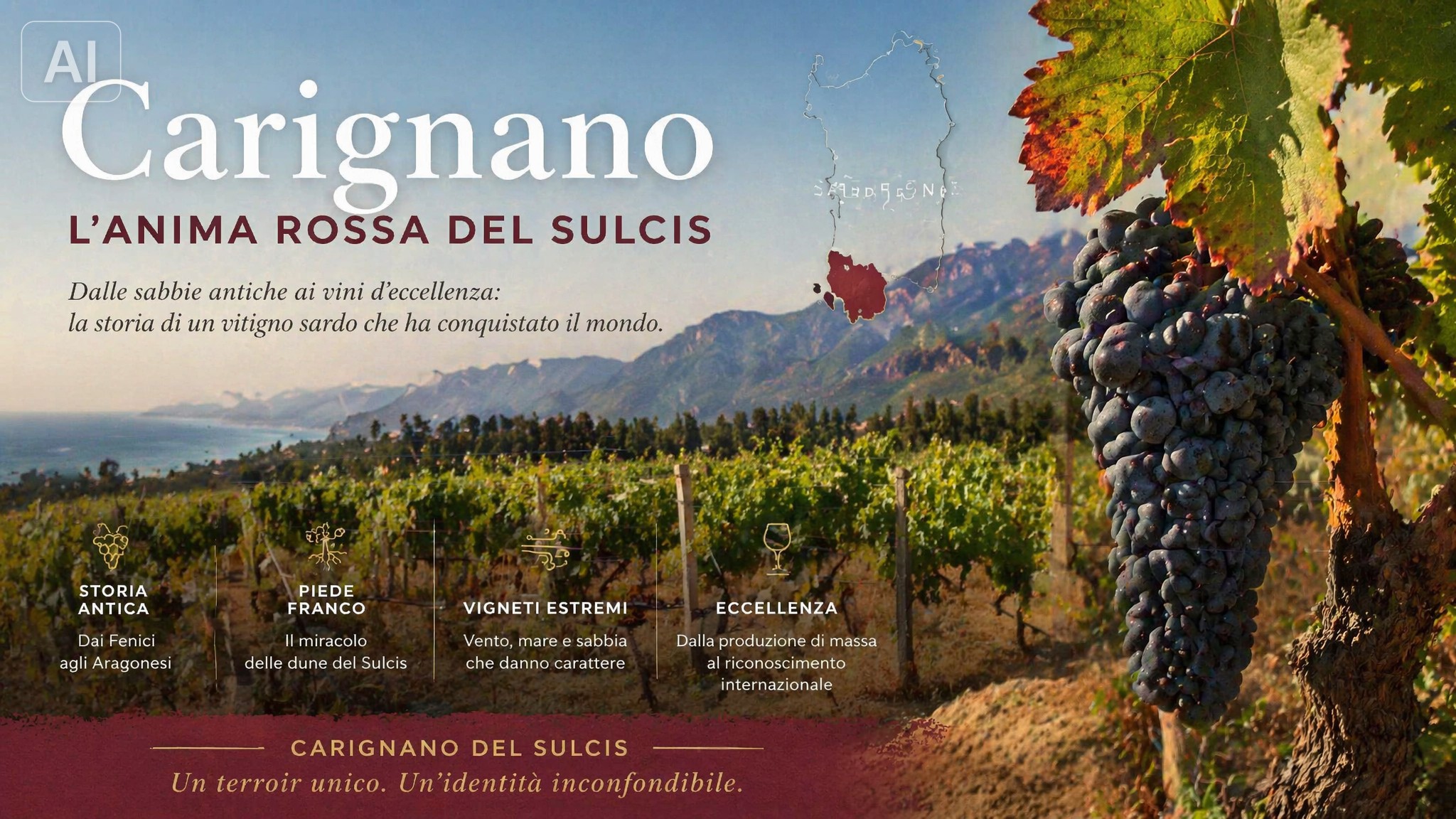
Abstract (IT): The wine ransom of Carignano del Sulcis: from historical international grape to excellence in purity of Sardinia. From the historical roots linked to Phoenicians and Aragons to the agronomic miracle of the vineyards on a free foot on the sandy dunes, able to resist the phylloxera and to give, thanks to low yields and targeted refinements, a powerful red wine, longevous and with an unmistakable sensorial profile.
Abstract: The oenological renaissance of Carignano del Sulcis: from a historic international blending grape to Sardinia's premier single-varietal excellence. From historical roots tracing back to the Phoenicians and Aragonese to the agronomical miracle of ungrafted (footnote) bush vines on sandy coastal dunes that resisted phylloxera, delivering—through low yields and targeted aging—a powerful, long-lived red wine with an unmistakable sensory profile.
The Carnation has lived for centuries a sort of enological paradox. abroad has long been considered a simple cutting grapes, grown for large volumes and shipped all over Europe to give color and structure to red wines of overseas. In Sardinia instead, this vine has found the ideal conditions to turn into a excellent red wine pure.
Historical origins: from Phoenicians to Aragon
The debate on origins of Carignano in Sardinia still divides historians. The most accredited hypothesis binds its introduction at the time of the aragonese domination (XIV century), period in which island viticulture receives the first official legal safeguards, such as the historical ones of the Carta de Logu.
However, there are fascinating theories that anticipate its presence: many scholars assume that the vine is landed on the island thanks to the Phynicians, which would have introduced it from the very beginningisland of Sant'Antioco and the coasts of Sulcis. Whatever its root, the official inscription to National Register of Vineyard Varieties back to top 1970.
The miracle of the free foot on the dunes of Sulcis
The true agronomic change takes place during post-phylloxic reconstruction at the end of the nineteenth century. While the whole of Europe was forced to plant the vineyards to use the American foot sandy soils of Sulcis and Sant'Antioco a primordial viticulture has been maintained.
The phylloxera fails to proliferate in the sand: this allowed the survival of historical vineyards bred to tree on a free foot. These coastal vineyards, with wind and close to the sea, grow under conditions drought and torrid climate, developing deep roots in loose soils and poor which naturally limit yield per hectare, concentrating aromas.
From mass production to international position
Comparison with foreign markets highlights the change in quality of the vine:
The French-Spanish model: In France (known as Carignan) and Spain (Cariñena or Cruñago), the variety has historically been exploited for its enormous productivity, which in the mid-20th century reached the 200 hectolitres per hectare. The Languedoc-Roussillon and Algerian wine industry used it massively to correct other blends.
Native organoleptic characteristics: The vine produces a strong grape acidity, tannins and intense color. If not properly managed in the vineyard, it gives origin to spigolose wines in youth and difficult to harvest mechanically because of the bunch firmly attached to the branches.
The evolution in Sardinia: Drastically lowering the yields and exalting the terroir hilly and coastal, sardinian producers have demonstrated the real evolutionary potential of wine.
Sensory profile and aging potential
Today Carignano del Sulcis is worked with calibrated macerations and targeted wooden passages (oak barrels or concrete tanks), which smooth the juvenile intrusion. The result is a red wine from intense ruby red color and the complex bouquet, which turns out round, fat and pleasant palate.
Its rich acid-organic component and the excellent alcohol level guarantee a perfect extractive balance and an extraordinary bottle longevity, placing it fully among the great red wines of the Mediterranean appreciated by international sommeliers.