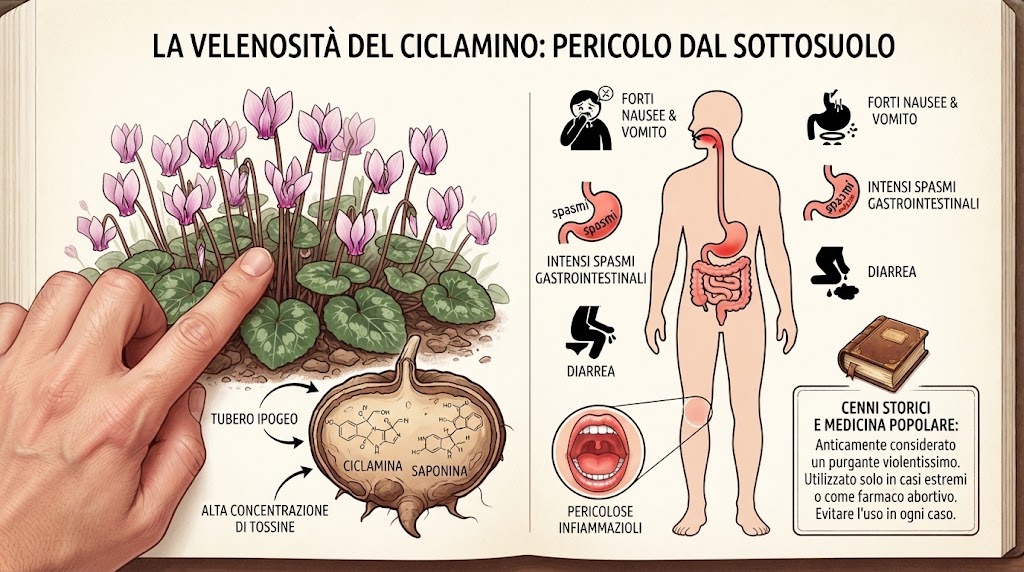
The spring cycle (Cyclamen replica or Cyclamen vernum), known in botany as a bulbous geophyte of the Primulaceae family, is a plant of rare beauty but with a deeply ambivalent face. Observing it in the shady woods or among the chestnut spots of Sardinia, with its pink flowers and the purpure fauce from the reflexed petals, it is difficult to believe that this flower actually hides a highly toxic phytocomplex. Yet, Sardinian folk culture and race has been able to live for centuries with this duality, transforming a poisonous plant into a real archive of medicinal remedies, amulets and stratagems of survival.
The toxicity and paradox of pigs: because it is a plant "of life and death"
The danger of cyclamen is mainly linked to the presence of glucosides, including the cyclamine and the soap, concentrated especially within the hypogean tube. If ingested by the human being, cyclamine triggers drastic effects: strong nausea, vomiting, intense gastrointestinal spasms, diarrhea and dangerous inflammations of the oral mucosa. In ancient times, in many popular medicine manuals, it was considered a purgante so violent to be used only in extreme cases or as an abortion drug.
But there is an exception that has fueled peasant curiosity for generations: the pigs. Pigs can feed on cyclamen tubes without experiencing any toxic side effects. It is precisely from this naturalistic observation that derives the common name of the plant, Bread (sing) Casu is polcu in some areas of Sardinia, as in Luras).
This strident contrast — a disarming beauty combined with mortal toxicity — led the tradition to consider the cyclamen a sort of life and death plant, associating it in the language of flowers to distrust and poor confidence, but also to a rigorous warning.
Sardinian Ethnobotanic: the popular names and extreme "rimedes"
In the oral tradition of Sardinia, the names attributed to the cyclamen tell the practical effectiveness and impact of its active ingredients on daily life:
Popular names: To Orani is called "kakkakù" or "tsittsia and kakka" (recalling the strongly purgating effect), while in Bene tutti takes the name of "tsittsia 'e kàkka" and Ollolai of "Senorèdda". Other popular names include Cyclaminu aresti, Pani di Sirboni, Cuccheddu and Lepured.
Traditional therapeutic uses: In the boot of Sardinian folk medicine, the tuber powder was previously toasted in Sadali, Seui and Seulo as a laxative blando. In Luras, instead, the proverb was used "give you au casu and polcu" to ironically indicate a useless or unwelcome gift, offering the porcino (non-toxic for pigs but unserved for man) to make it clear that the recipient did not deserve any real gift.
Magical beliefs and stratagems: In Nuoro it was believed that the tuber possessed magical powers: keeping one in his pocket was enough to cure the frosts, making them disappear gradually as the tuber dried. In Corsica and in some areas of Sardinia, the caustic action of the tuber cut was exploited by applying it on the knees to cause a swelling such as to be incapable and avoid military service.
Historical emergency: In times of extreme famine, as during World War II, despair pushed to exploit the tubers — rich in starch — as flour surrogate, or, after careful drying which reduced its toxicity, the powder was used as a sneezing to cure cold.
Historical and mythological curiosity in the Mediterranean
The link of the cyclamen with man crosses millennia of Mediterranean history:
The scientific name: The term Cyclamen derived from Greek kyklos (circle), in reference to the round shape of the tuber or, according to other authors, to the particular spiral movement that performs the floral peduncle after the nuance to interrate the seeds (also aided by the ants that feed on the envelope).
Fish and ancient deceptions: Pliny the Old and Dioscorides mentioned the plant under the names of Rapum, Tube or Humanities of the earth. The Greek name Ichhoyethon referred to the custom of mixing the tuber to other ingredients for stunned fish in waterways.
Protective amulets: In antiquity it was believed that the cyclamen protected from the malefices, gaining the name of amulet and the reputation of remedy against the bite of snakes.
A wild plant that contains in a few centimeters of foliage and underground tubers a real microcosm of chemistry, anthropology and island history, reminding us how nature knows how fascinating and ruthless at the same time.