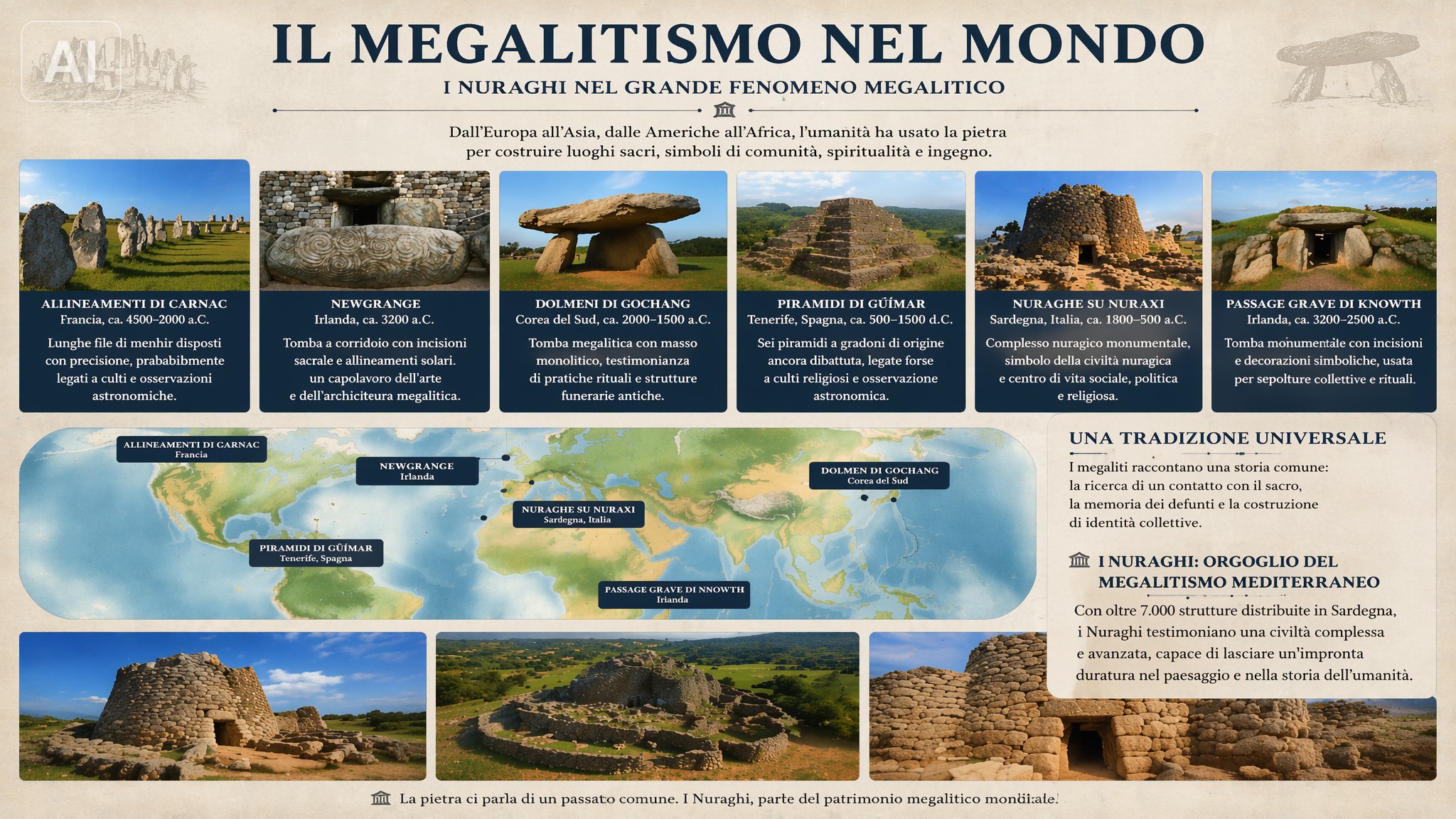
Abstract (IT): A journey to the discovery of global megalithism: from Brittany and Stonehenge to the islands of Malta and the Balearics, to the Asian and South American traditions. An investigation into universal motivations — astronomy, ancestors' worship and land affirmation — culminating in the engineering apex of Nuragic Civilization in Sardinia, among cyclopic towers, sacred wells and suggestive historical hypotheses.
Abstract: A journey global exploration megalithism: from Brittany and Stonehenge to Malta and the Balearic islands, down to Asian and South American traditions. An investigation into the universal motivations—astronomy, ancestor worship, and territorial claim—culminating in the engineering peak of Sardinia's Nuragic Civilization, featuring cyclopean towers, sacred wells, and complling historical hypotheses.
The term "megalitism" comes from the union of Greek words megas (big) and lithos (stone). This definition identifies one of the most fascinating architectural and spiritual manifestations of human history: the construction of colossal monuments made with large stone blocks placed dry, or without the use of mortar or cement.
Sardinia is often seen as an isolated case, but the reality is much wider. In different times and in every corner of the planet, very distant civilizations among them have felt the same need: to raise monumental stones to challenge time and to dialogue with the infinite.
From the coasts of Brittany to the Pacific islands, the stone was the first true universal language of humanity. We discover the main stages of this global journey and how the nuragic civilization has represented the engineering apex of this tradition.
The European cradle: the megalith of the Atlantic Arc
Western Europe is home to one of the largest concentrations of megalithic monuments in the world, which have emerged mainly during the Neolithic period (between 4500 and 2000 BC).
- Brittany (France): It is considered the pulsating heart of Atlantic megalithism. The alignments of Carnac, with their rows of thousands of menhirs running in the countryside, remain an open archaeological mystery. These include monumental stone burial mounds such as Barnenez.
- British Islands: The absolute icon is Stonehenge, in England, a circle of stonescromlech) demonstrating an extraordinary mathematical and astronomical knowledge for the time. In Ireland and Scotland, however, the corridor dolmen stand out as ♪, famous for their precise solar orientation: at the dawn of the winter solstice, the light penetrates perfectly to the burial chamber at the bottom.
Megalitism in the Mediterranean: islands in comparison
In the Mediterranean basin, the architecture of the stone has followed an original evolution, deeply linked to the identity of the great islands.
- Malta: The complexes of Jagantija and HERMANY are among the oldest religious buildings in the world, before the same pyramids in Egypt, and stand out for a lobed plant of great complexity.
- Balearic Islands (Spain): The talaiotic culture, flourished in Menorca and Majorca, shows strong points of contact with Sardinia. He left as a testimony talayots (vitation towers) and taulas, mysterious "T" structures composed of a vertical stone that supports a horizontal one.
- Sardinia: In this scenario, the Civilization Nuragic represents the culmination of the megalithic architecture of the Mediterranean. The Sardinians were not limited to erecting individual stones, but specialized the cyclopical technique to build more than 7,000 towers (nuraghi), fortified villages, well temples and imposing Tombs of the Giants.
Asian expressions and giants of South America
The need to build through the monumental stone has crossed the oceans, manifesting itself in different forms and times.
The Dolmen of Korea and traditions live in the Pacific
The Korean peninsula holds a real world record: it concentrates alone almost 40% of existing dolmen on the planet (the sites of Gochang, Hwasun and Ganghwa are protected by UNESCO), where megalithism continued to the full Bronze Age. In the Indonesian islands of Nias and Sumba, however, the phenomenon remained an anthropological tradition alive until the modern era, with the erection of stone monuments to honor ancestors during community rituals.
The Great Walls of South America
In pre-Columbian cultures, the technical ability to transport and cut colossal stones has reached extraordinary levels. A Tiahuan (Bolivia), near Lake Titicaca, geometric blocks challenge modern theories on Andean lifting systems. In Peru, the colossal walls of Sacsayhuamán, made with mass of several dozen tons perfectly framed dry, share the same human obsession for the permanence of the stone.
The focus: the Nuragic Civilization in Sardinia
The nuragic civilization is not the result of an external invasion, but the evolution of the local populations already present in Sardinia since the Neolithic and known for the production of ceramics, metals and first megalithic structures (menhir and dolmen).
When in the Bronze Age the Sardinians began to erect their dry trunk towers, they demonstrated unique engineering skills in the European landscape.
Nuraghi, pozzi sacri e la leggenda di Shardana
I nuraghi constitute the heart of this civilization. Used as fortresses, sighting towers, warehouses or prestigious symbols, they evolved from isolated structures to real complex villages.
The spiritual life of the Nuraghic Sardinia instead rotated around the water worship, as the sacred well temples testify (the sanctuary of Santa Cristina it is the most famous example for geometric precision), and the cult of the dead with the Giant Tombs. Sardinians were also skilled metal traders in contact with Mycenaeans, Phoenicians and Etruscans.
In addition, a historical theory supported by Professor Giovanni Ugas connects ancient Sardinians to Shardana, one of the "Popolis of the Sea" mercenaries who, according to Egyptian sources, contributed to the collapse of the Bronze Age in the eastern Mediterranean.
Summary: Why did humanity build with the megaliths?
Analyzing these cultures so distant, three universal and deep motivations emerge that unite all stone builders:
- Astronomy and sacredness: Almost all monuments in the world are oriented towards solstices or equinoxes. Stone was the only material capable of blocking time and connecting to the movement of the stars.
- The cult of ancestors: Megaliths are often collective tombs or sacred spaces dedicated to those who are no longer there. Building monumentally meant making immortal ancestors and turning them into the guardians of the place.
- Land settlement: A stone monument launched a clear visual and political message to visitors or rivals: "This territory is occupied, organized and protected".
Under the medieval, Pisan or Spanish foundations of our cities lies the silence of the nuragic civilization. Sardinia is not an isolated exception, but one of the most glorious, engineering and best preserved chapters of this extraordinary global history.