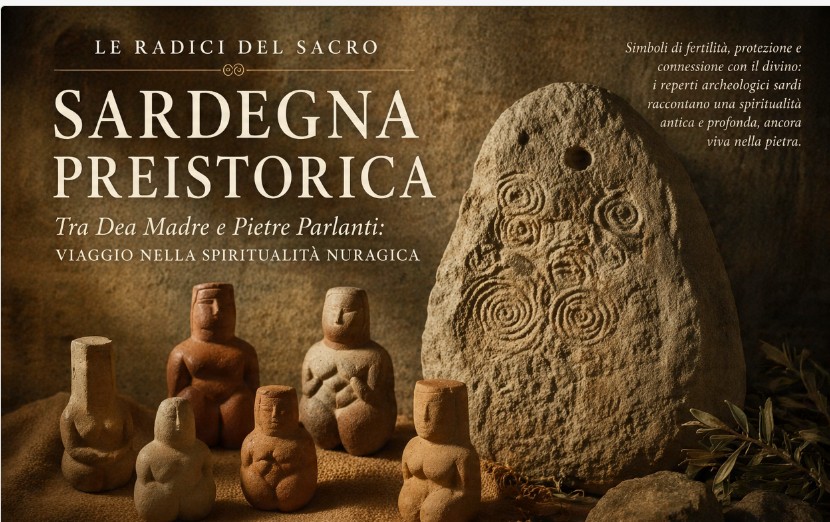
Abstract (IT): A mystical and archaeological journey through time and space in Sardinia, where stone becomes a living language. From the estimates domus de janas dug into the belly of the earth to the imposing perdas fittas (menhir) point to the sky, to the monumental enigma of Monte d'Accoddi: a journey between the millennia to discover the sacred dialogue between man, the Goddess Mother and the universe.
Abstract: A mystical and archaeological journey through time and space in Sardinia, where stone becomes a living language. From the intimate domus de janas carved into the womb of the earth to the obligatory perdas fittas (menhirs) reaching towards the sky, up to the monumental enigma of Monte d'Accoddi: a millennium-long path exploring the sacred dialogue between humanity, the Earth Mother, and the universe.
Imagine walking in a land where time never runs, but it settles, layer after layer, as the rock itself on which we rest. In Sardinia the landscape is not only nature, it is a true book open under the sky of the Mediterranean, where every menhir and every hypogea tomb are not simple objects, but words of an ancient history that tells a silent dialogue between man and invisible.
Everything begins in the deep, in the womb of the earth, where domus de janas become the welcoming refuge for those who have finished their journey. Here, among the walls sculpted in the image and likeness of everyday houses — with those two-phalt ceilings, the hids and even the focolare engraved in the rock which still seem to preserve the heat of a distant fire — the dead were not only buried, but accompanied with care in the eternal. It was an intimate cult, almost a domestic prayer, where the Goddess Mother watched on the threshold, her stylized image to protect the sacred passage between life and mystery.
But the soul of these people, in a perfect balance that resembles the dance of the seasons, felt the need to balance that dark underground with the light of the sky. This is where the perdas fittas, the great menhirs that challenge the millennia becoming fingered towards the stars. Imagine you are among the energy-filled silences of Biru 'e Concas or Pranu Muttedu: you are not walking between simple stones, but in a true assembly of giants. Some are massive and crude, as protuberances born from the earth, others instead begin to become thin, becoming protoanthropomorphic, as shadows projected by the sun, until they become, in rare and precious cases, human figures with a face, a nose and a soul carved in the stone.
While in the graves the cult concentrated on the bull — that bucranium that with its iterate horns embodies the male force and fertility of the passage — the menhir makes a different gesture, almost an ancestral embrace: it is the male principle that, stuck in the ground, fertilizes the Mother Earth, transforming the field or grazing into a consecrated space, just as the spirals engraved on the stele of Boeli to Mamoiada, which more than simple decorations seem labyrinth to map the path of the soul.
It is an uninterrupted conversation between man and the universe, which finally, almost as a breath rising from below up, comes to Sassari. Here, Monte d’Accoddi abruptly rises like a Middle Eastern ziggurat in a Mediterranean landscape, marking the moment when the Sardinian man decides to detached himself from the ground to question the stars. The rite abandons the belly of the earth to celebrate the light in what we call 'high place', a red temple where the goddess is no longer just mother of the ground, but becomes Lady of Heaven.
All this evolution, which goes through millennia of stories, teaches us that Sardinia has never been isolated, but a vibrant stage ofwhere cultures like that of Bonuighinu, with its volumetric idols, have intertwined with the refinement of Ozieri, bringing with it the oxydiana of Monte ArciCopper, and that incessant need to understand what is beyond the horizon. Every stone we encounter, from the simplest dolmen of Sa Coveccada to the complex defensive walls of Monte Baranta, is a piece of this story that, like a red thread, binds our land to the very roots of the sacred in the world.