Abstract (English)
The present essay explores the Marmilla, a historical subregion of central Sardinia characterized by a unique landscape of sweet hills, basaltic plateaus and archaeological evidence ranging from prehistory to the Middle Ages. Through a thorough analysis that combines geography, geology, institutional history — from the splendour of the Judges and the Charter of Logu to the severity of the Spanish feudal regime — and cultural anthropology, the text examines the central role of strategic centers such as Sanluri and the forty-five villages of the territory. Despite heavy historical evidence, from famines to epidemics, and modern challenges of depopulation, Marmilla emerges as a "place of the soul", custodian of a resilient identity and immaterial heritage handed down through oral traditions, sacred architectures and consortia of territorial enhancement.
Abstract (English)
This ity explores the Marmilla, a historical subregion of central Sardinia characterized by a unique landscape of rolling hills, basaltic plateaus, and archaeological heritage spanning from prehistory to the Middle Ages. Through an in-depth analysis combining geography, geology, institutional history — from the splendor of the Judicates and the Carta de Logu to the severity of the Spanish feudal regime — and cultural anthropology, the text examines the pivotal role of strategic such as Sanluri and the territory's forty-five villages. Despite heavy historical trials, from famines to epidemics, and the modern challenges of depopulation, the Marmilla emerges as a "place of the soul," guarding a resilient identity and an intangible heritage passed down through oral traditions, sacred architecture, and territorial promotion consortia.
Where time spreads, between gentle hills like hugs, millenary stones and the resilient soul of a people.
A Place of the Soul: Introduction to Subregion
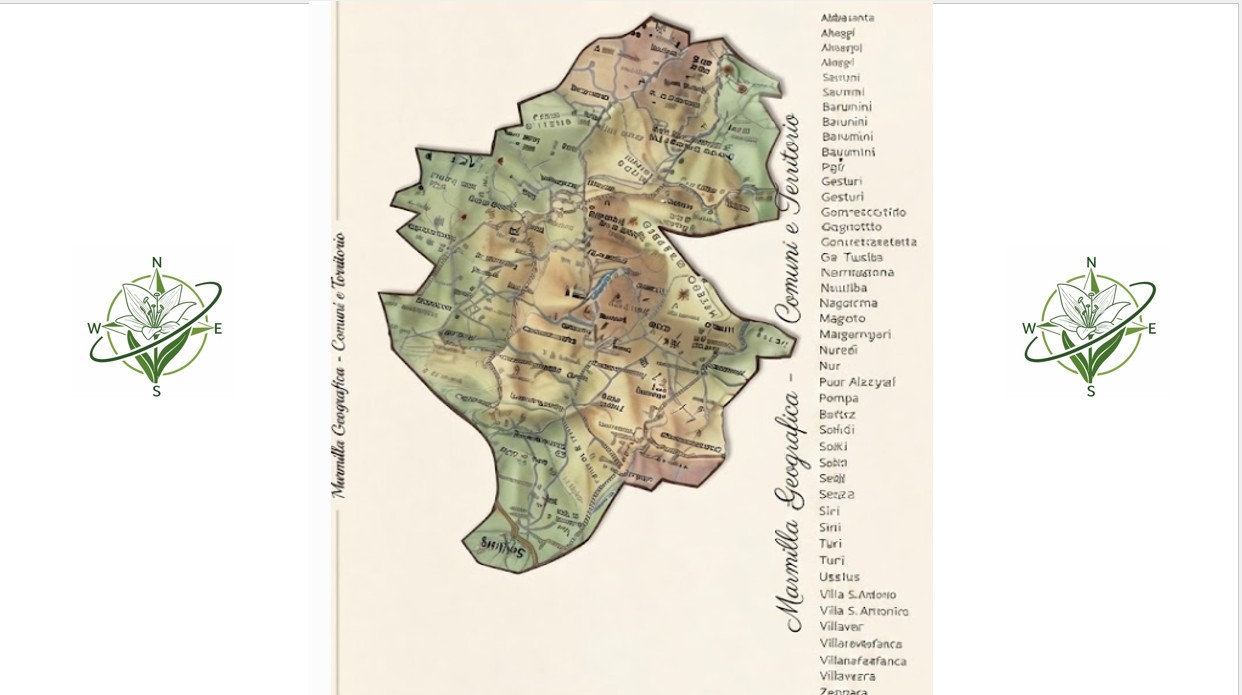
The Marmilla is not simply a territory marked on a geographical map: it is a real place of the soul, a millennial stage enclosed between gentle hills, large fertile valleys and horizons that seem never to end. It is a historical subregion of Sardinia formed by forty-five countries (plus some fractions), a territory that preserves one of the most ancient and fascinating stories of the Mediterranean, where modernity has turned late, leaving intact an authenticity made of silences, millenary stones and a deep humanity.
The name itself evokes ancient suggestions: it is said to derive from Mammilla, in reference to the hills of the territory, low and of breast-like appearance. A name that perfectly paints a land "mother", which extends between the Campidano di Oristano, the Sarcidano and the Trexenta, bounded by basaltic plateaus such as the Giara and the reliefs of Monte Arci.
Geological Origins and Imprinting of Prehistory
From the geological point of view, Marmilla is an open-air museum born in the lower Miocene (about 24-20 million years ago), when the island underwent a sea penetration that made this part an archipelago. The sedimentation of sands, limestones and forms of cooling of volcanic origin (as near Masullas or Gonnostramatza) shaped a unique landscape.
On this natural stage, man has left indelible traces since the night of time:
- Megalithic Testimonials: ♪ Domus de Janas (a) Dolmen, to the majestic Menhir (le perdas fittas), like the famous menhir of Cuccuru Tundu at Villa San Antonio, almost six meters high.
- L'Epopea dei Nuraghi: Tropical-conical towers built with cyclopic mass that emerge everywhere, guarding a territory that over time saw the alternation of Phoenicians, Carthaginians and Romans.
The Middle Ages, the Judges and the Charter of Logu
In the Middle Ages Marmilla found strong institutional and geographical cohesion. In the document of 20 July 1219, in which the judge of Cagliari Torgodorio grants the territory to his son Saluccio, historical places and villas are mentioned as Sas Lacanas: Mara Arbaressa (Villamar), Villanova Franca, Villa de Segaciu (Segariu), Villa de Fortey (Furtei).
The territory was the beating heart of the Judged of Arborea. To confirm its strategic importance, the village of Villamar was chosen in 1366 as the seat of the assembly of peace between the King of Aragon and Judge Eleonora d'Arborea. And it is always in this context that the Sardinian legal civilization expressed its masterpiece: Map of Logu, promulgated by Eleonora, who organically disciplined the life of Sardinians.
Sanluri: The Strategic Crossroads and Medieval History
Sanluri is described as the most populous center of Marmilla and a strategic knot of primary importance.
- Geographical and administrative centrality: Located on State 131 (Cagliari-Sassari), Sanluri is home to important offices such as Catasto, Pretura, the Register Office and the headquarters of the Bank and the INAIL. With its eighteen municipalities, it is the capital of the Middle Campidano and the South Marmilla, while addressing over time the problems related to the depopulation of small centres.
- The Castle and Medieval History: The country originally marked the border between the Judge of Cagliari and the Judge of Arborea. The famous medieval castle (now owned by the Counts of Villasanta) was a theatre in 1409 of the famous battle of Sanluri, where the Aragonese troops defeated the Arborene troops. In memory of this defeat still loses the name ♪, place of slaughter.
- Traditions and Events: The village promotes historical reenactments of great interest as "Sa Batalla" in June, with historical parades, medieval costumes and the representation of the arts and crafts. It is also linked to the event of the "Villa" of Las Plassas for the recovery of medieval civilization, culminated in 2003 with the entry into the "European Consortium".
Sacred Architecture and Devotion in the Borghi
Walking through the villages of the Marmilla means entering into jewels of Romanesque architecture and campestre that resist at the time:
- Sanluri - The Parish dedicated to the Virgin of Graces: Of 16th century origin, it was modified in 1786 with a structure in Piedmontese baroque style (work of G. Viana). The interior is a basilica with three aisles, rich in marble and works of art. Inside there are chapels dedicated to S. Pietro, S. Lorenzo, S. Martino, S. Anna, S. Rocco, S. Sebastiano and S. Francesco. The patronal feast takes place on July 2nd.
- Sanluri - The Franciscan Convent: Built in 1608, its ancient original church reached us before the chapel on the left. It preserves a large terrace from which you enjoy a magnificent view.
- Siddi: With the church Santu Mialia (San Michele), dating back to the 13th century, characterized by a Romanesque-Pisana structure and a precious entrance archive carved with human figures.
- Mogoro: The church S. Leonardo (XII century), which rises in a small square with a single nave and circular apse.
- Villanovaforru: The sanctuary S. Marina, built in 1280 on a hill in the south-western area, witness to a deep devotion that crosses the centuries.
- Usellus: Where the little church S. Lucia It stands on the basaltic plateau, surrounded by nuragic towers and by the invitation to prayer that merges with the silence of nature.
The Spanish Domain and the Feudal System
The story of the Marmilla opens a severe scenario about the arrival of Spanish domination. The subregion underwent a heavy feudal regime characterized by asphyxiating tributes, religious restrictions and the so-called Spanish "cleaning" which also struck the Jewish communities established on the island.
The noble families who divided the villages of Marmilla include:
- Gesturi and Tuili: Gherardo Dedoni.
- Barumini and Las Plassas: Holy Cross, Zapata, Besalù.
- Villanovafranca: Zapata, Besalù, Centelles, Osorio.
- Setzu and Turri: Osorio, De La Cueva, Castelví.
- Villamar: Aragal, Alagon, Ajmerich, Dedoni, De Tolono.
- Villanovaforru: Carroz, Centelles, Osorio.
7. Oral Traditions and Popular Tale: "Is Signoricus"
The material and intangible culture of Marmilla also lives through cross-sections of cultural anthropology and popular narrative:
- Is Signoricus (The Lords): In Sanluri it is said of a comitive of wealthy people who stopped near the civic palace to drink nicely or ironize on poor or unfortunate people.
- Poetry and Memory: There are verses and devotional and popular songs in Sardinian (such as texts dedicated to Our Lady and San Lorenzo – "You sis angelu terrenu omini celestiali. . "), handed down by the voice of historical witnesses like Aunt Arrita Aresti.
8. Between Poverty, Tragedies and the Great Heart of the People
The history of Marmilla, however, is not only made of stone and landscape beauty; was marked by hard evidence:
- The Feudal Joke and the Calamity: The territory has suffered for centuries the weight of feudal exploitation and historical plagues: the terrible plague of 1652, the recurring famines (such as that of 1540 and 1629), the invasions of cavalry, the malaria originated from the marshy areas and the violence of the abuses.
Yet, it is precisely in this scenario of apparent fragility that emerges the true wealth of Marmilla: its people. A community of people with a big, resilient heart, able to cling around their churches and traditions. Today, through tourist consortia (such as Sa Corona Arrubia, Consorzio delle Due Giare, G.A.L. Sa Jara and Su Nuraxi) and the valorisation of agricultural and craft products, the countries of Marmilla are struggling to seize their future, combining the memory of the past to the hope of a rebirth.
Bibliographic sources and references
- Costa, M. History of Sardinia and its historical monuments. Cagliari: Regional editions, 1998.
- Casula, Francesco Cesare. History of Sardinia: Political, economic, social and cultural evolution from prehistoric times to contemporary age. Sassari: Carlo Delfino Editore, 1994.
- Tola, Pasquale. Codex Diplomaticus Sardiniae. Turin: Typographia Regia, 1861 (for medieval historical documents and judicial territorial concessions).
- Raspi Paper, Raimondo. Sardinia dei Giudicati. Cagliari: Of the Church, 1969.
- Lilliu, Giovanni. The Sardinian civilization from paleolithic to the age of nuraghi. Torino: ERI, 1988.
- Pintore, Gianfranco. Sardinia: Identity and history. Nuoro: Ilisso Edizioni, 2001.
- Municipal Historical Archives of Sanluri. Documents and memories on the Battle of Sanluri and feudal assets of the Middle Campidano. Sanluri, local editions.