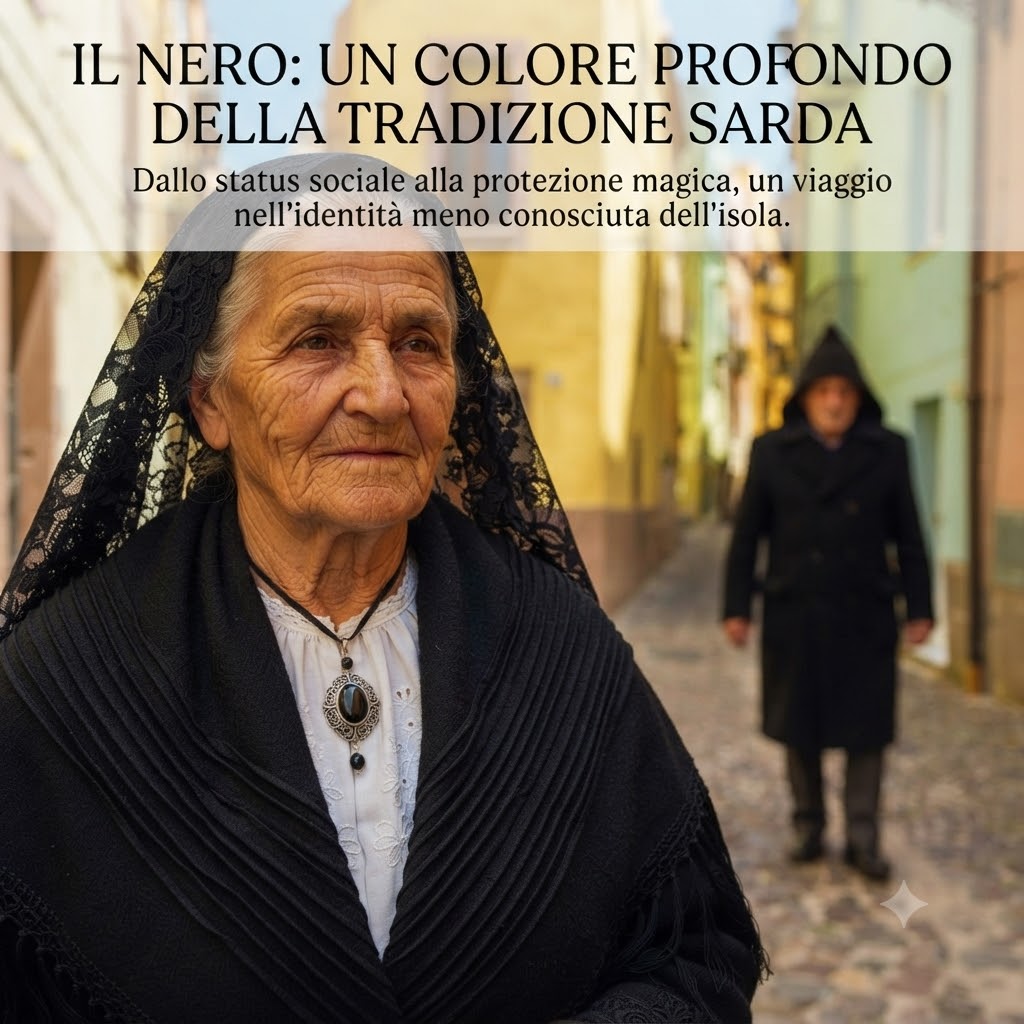
Abstract (IT):Beyond the clichés of bright colors: a journey to discover the black color in the Sardinian tradition. Not only symbol of mourning, but ancient status symbol of social prestige, color of choice for traditional wedding dresses, powerful apotropaic amulet against the evil eye (like the famous kokko) and armor material in the agropastoral resistance of the orbace.
Abstract:Beyond the clichés of bright colors: a journey to discover the color black in Sardinian tradition. Far from being taught a symbol of mourning, black served for centuries as an ancient status symbol of social prestige, the color of choice for traditional bridal gowns, a powerful apotropaic amulet against the evil eye (such as the famous kokko), and the Elegant material armor of agropastoral resilience in orbace.
When thinking about traditional Sardinian costumes, the mind immediately runs to an explosion of bright colors, bright reds, whites and golden embroidery. Yet, digging in the history and ethnography of the island, emerges an unexpected and fascinating protagonist: the color black.
Far from being confined to the only symbolism of mourning, black has for centuries played a crucial role in Sardinian identity, woven with social status, rites of passage, magic protection and material culture.
The dress of the festival and social prestige
In the traditional clothing of many Sardinian communities, the elite dress or the one reserved for the great solemnities was not colorful, but entirely black.
The complexity of dyeing: Historically, getting a deep, dense and lasting black on fabrics such as wool, orbace or damask silk was a complex and costly technical operation.
A status symbol: Because black fabrics of poor quality tended to fade quickly with everyday use, displaying finely packed black dresses was a sign of high prestige. This clearly indicated the ability to distinguish ordinary time from the extraordinary time of the feast.
The mystery of the bride: the ancient wedding dress
One of the most amazing aspects of Sardinian tradition is marriage. In different communities of the interior (as at Oliena), the old wedding dress of the brides was not white, but strictly black.
From an anthropological point of view, this use was rooted in an ancient symbolism linked to new moon: the black moon, hidden and virgin, was considered at the same time the bearer of mystery, fertility and promise of a lush family renewal, before being progressively replaced by the hegemony of white.
The Kokko: the black stone against the evil eye
Black in Sardinia also has a strong apotropic value, that is protective. It is a perfect example of the famous kokko (also known as coconut or sabegia): a traditional amulet composed of a black and bright stone — typically bituminous or oxydiana lignite — set in silver.
It was traditionally pinned on the baby's cradles, sewn inside the dresses or worn as a protective pendant by pregnant women.
Its function was to "capture" and deviate the evil gaze of envy and evil eye, exploiting the dark gloss of stone to distract negative energies.
Material and resistance: the Orbace and the earth
Finally, black and dark shades of raw wool (often linked also to the autochthonous black sheep) constitute the armor of agropastoral life.
THEorbace, the robust wool cloth felt waterproof in the wind and rain, was exploited in its natural tones or dyed with poor soil pigments. For shepherds and peasants, wearing the dark cloth meant dressing the daily resistance against the weather of Gennargentu and the harshest territories.
Rediscovering the black color in Sardinian culture means overcoming the visual clichés and entering into an ancient code, where elegance, protection and collective memory merge into a single, deep shade of identity.