Abstract (IT): A trip to Phoenician-Punica Sardinia, when the island was the heart of the Mediterranean. From the deep colonization and urbanism of Monte Sirai to the scientific rigour of Giovanni Spano and Sabatino Moscati, who unveiled the true nature of the Tofet. A heritage that still lives today in the gastronomic techniques of Sulcis, in the cult of pomegranate and in the magnificent beauty of the coastal sites of Nora, Tharros and Bithia.
Abstract: A journey Phoenician-Punic SardiniaWhen the island was the beating heart of the Mediterranean. From the deep colonization and urban planning of Monte Sirai to the scientific rigor of Giovanni Spano and Sabatino Moscati, who unveiled the true nature of the Tofet. A legacy that still lives on today in the gastronomic traditions of Sulcis, the symbolism of the pomegranate, and the magnificent coastal sites of Nora, Tharros, and Bithia.
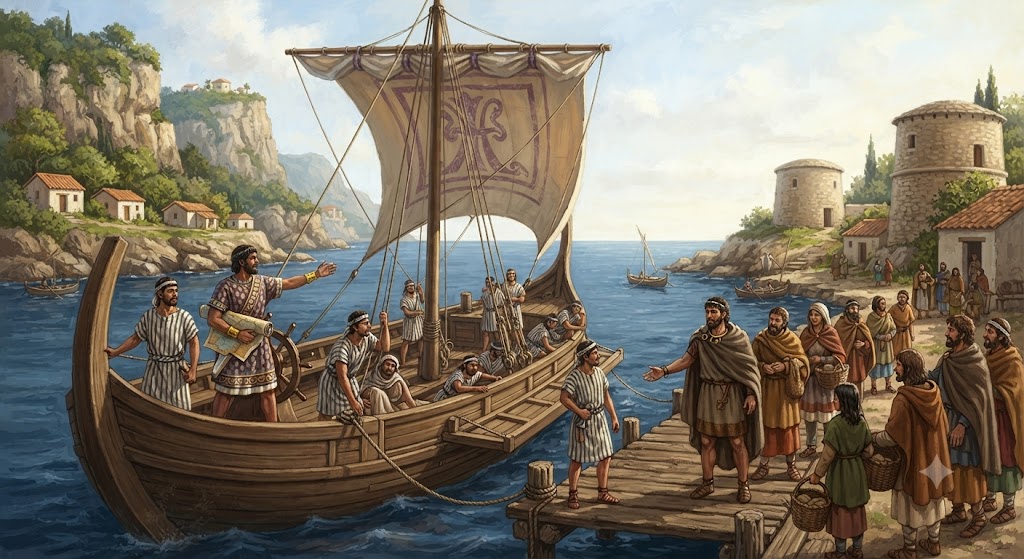
Have you ever tried to close your eyes, looking at the sea of Nora or Sant’Antioco, and to imagine how Sardinia was 2.500 years ago? Do not think of a lost island: at the time we were the heart of the Mediterranean. An incredible crossroads where Phoenicians and Carthaginians arrived, traded and settled, transforming our landscape forever.
The silent revolution: not only traders
We often imagine Phoenicians only as navigators of passage. In fact, their arrival in Sardinia was a real revolution. They have not limited themselves to creating coastal emporia: in Sardinia they have implemented a deep penetration, managing the territory, agriculture and resources in a capillary way, reaching the hinterland. We think of Monte Sirai: here their presence was not only commercial, but it became a real political conquest that overwhelmed the previous arrangement, leaving us structures to quadrangular plan that we still look with wonder.
How did we figure this out?
The stones don't speak for themselves, but they started to tell us their story thanks to those who heard them.
- The Canon Giovanni Spano: Without him, our heritage would have been devastated. In the nineteenth century, while the sites were systematically plundered, Spano was the first to give a scientific order to the finds, saving the historical memory of Sardinia from oblivion.
- Sabatino Moscati: In the 1960s, the real breakthrough. Moscati was not only a desk academic, but a visionary who understood how crucial it was to combine theory with field practice. Together with figures as Gennaro Fish and Ferruccio Barreca, gave way to systematic excavations that forever changed the interpretation of the sites, such as the fundamental one of Sant’Antioco.
Beyond the myth: the truth of Tofet
One of the most extraordinary results of this scientific method is Tofet. For decades, based on distorted biblical interpretations, it was painted as a place of dark rites and raw sacrifices. Thanks to the rigor of the researchers, today we learned to read it for what it really was: a sacred area dedicated to children, a place of devotion where parents expressed their hope and protection towards divinities like Baal Hammon and Tanit.
An inheritance that you eat and breathe
Phoenician-punica history is not closed in a museum; it still lives in our traditions. Think of the wisdom in the conservation of fish, such as tuna and bottarga, or the wise use of salt and spices: they are techniques that sink the roots in that period, when marine resources were managed with a cutting-edge technology that shaped the gastronomic identity of areas like Sulcis. And then there is the pomegranate, a symbol of fecundity par excellence, which still today we find depicted in the finds and which traveled with them here.
Why visit these sites?
Visiting Nora, Bithia, Tharros or Monte Sirai does not mean "seeing ruins". It's an immersive experience. Walking through these walls means connecting with a cosmopolitan Sardinia, able to merge nuragic traditions and oriental influences in a unique, fascinating cultural mosaic.
Next time you organize a trip, try to look beyond the panorama. Look for the signs of those who made this island great before us. It is a story that still vibrates, which continues to speak to us through the work of those who, like Spano and Moscati, chose to dedicate their lives to preserve it.