From the ancient name to the bond with the Mediterranean
The name Cannonau (also called Cannonao) has its roots in a linguistic and historical complex charm. According to some linguistic hypotheses, the term would be comparable to the Assyrian-Babylonian Kannu-naum (alBEREllo nostra), although the true critical knot concerns the phytonymous and semantic link between Cannonau, the Garnacha Spanish and Grenache French, in addition to the historical term Vernaccia (white wine) with which these same varieties were once indicated. Fundamental historical studies, such as those of the French botanist Pierre-Jean Legrand d'Aussy (second half of the eighteenth century) and Count Alexandre Odart in his 1845 treatise (Traité d'Ampélographie Universelle), have long debated the origin of the vine. If at first it was believed that the Grenache was autochthonous of Roussillon or introduced in France by the Spaniards, subsequent research (including Roger Dion's) highlighted how the use of the name Grenache originally indicated a white wine (the Vernaccia), and only towards the end of the eighteenth/nineteenth century the name is slipped to indicate the current red wine.
In Spain, similarly, the word Garnacha or Garnatxa it was originally derived from Italian Vernaccia, identifying white wines at least until the 17th century (as attested by Miguel de Cervantes in 1613 in the novella El licenciado Vidriera, where the Garnacha appears in a list of Italian white wines appreciated). Only from 1734 and the Spanish Dictionary of 1780 the word Garnacha begins to be definitively referred to a red wine (wine dyed), stabilizing in subsequent treaties (such as those of Antonio Blanco Fernandez and Giulio Balbi Valier in the 19th century) as the most widespread black berry grape in Aragon and throughout the Iberian peninsula.
Molecular and genetic biology: the roots in Sardinian territory and parental
If the terminological history has often confused the tracks, the Modern molecular biology revolutionized the scientific approach, making clarity on the genealogical tree of the vine.
Thanks to an international collaboration betweenAGRIS Sardinia of Cagliari, the University of Milan-Bicocca and the Department of Agriculture of the University of La Rioja in Spain, it was possible to analyze microsatellite profiles (AKINAS genetic profile), reaching extraordinary results:
Genetic identity: A complete genetic identity has been found between samples of Garnacha Spanish and Spanish Cannonau
Philogenetic relations: The research, combined with the studies of Frare et al. (2010) on molecular biology and the relationship between Caucasian and European varieties, shows that the Cannonau, with most Sardinian varieties, it tends to group in the vicinity of Armenian and Georgian varieties, presumably in view of the greater proximity to the comparative genetic base represented by wildlife.
Sardinian priority: The traces of Cannonau in Sardinia are not only well rooted (quoted in notary acts since the first half of the sixteenth century as a fixed element of regional vitenology), but precede chronologically of two centuries the first documented evidence of its great diffusion in Spain.
Cannonau: diffusion, agronomic characteristics and variability
The Cannonau historically represents the most popular black berry vine in Sardinia, cultivated especially in the eastern part of the island for the production of a very full and rather dry red wine. Despite a significant stretching over the past decades, in 1990 it still occupied an area of about 11,000 hectares throughout the island.
General ampelographic characteristics:
Germage appy: It is presented with fan, arachnoid and herbaceous, with golden or slightly pinkish colouration and shady hair.
Adult leaves: Medium, reniform, trilobed or rarely quinquelobata; petiole breast open to lira, with slightly marked lateral breasts. Corrugated smooth surface, bright green and completely glabra on both pages. Medium pronounced teeth, slightly marked, biserrated or semi-serrat.
Poplar: Medium size (weight of about 190-250 g), troco-sferoidal or obovoid, with blue-violet, thin but consistent skin, very pruinous. The pulp is juicy, of soft texture, with a period of medium-term invasiveness that allows it to overcome the spring frosts and to mature in mid-September.
The peculiarity of the variant: the "Cannonau Rosato"
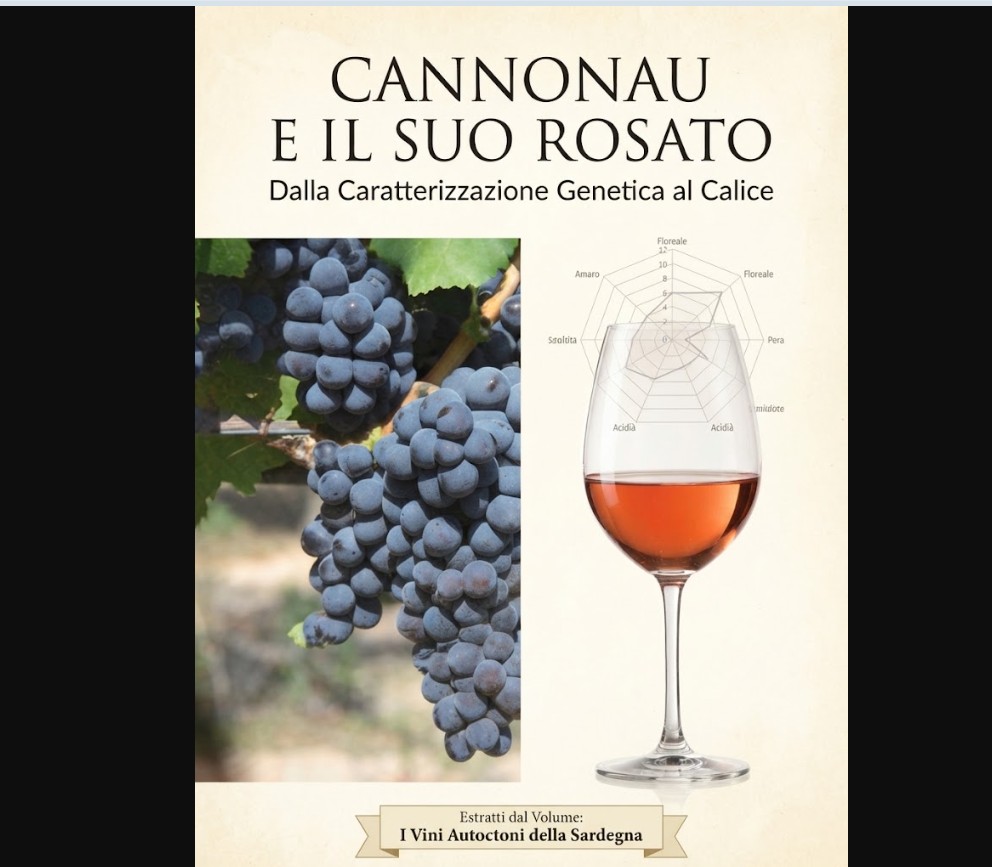
Next to the famous red berry vine, the variant of the red berry is very interesting. Rose Cannonau, studied in depth through the projects of conservation and characterization of the germoplasm (such as that conducted at the farm of Agris Sardegna in San Michele di Ussana).
Origins and genetic characterization of Cannonau Rosato
The Rose Cannonau is the result of the intersection between Cannonau and theWhite apesorgia. The access of reference comes from an old vineyard located in agro of Sestu, a vine whose cultivation is unknown in other areas of the island. As white Apesorgia is a parent and not a widespread variety outside the southern area of Sardinia, it is assumed that its range is limited to this area.
Morphology: Very productive variety, has leaves and bearing that stand out from the classic Cannonau for the color of the hook (pink or red, with anthocyanin pigmentation of the pulp Nothing) and for the flower, which is morphologically feminine (to stamina reflections and fully developed gyneceum) and comes directly from the parent white Apesorgia.
Genetic Dendrogram: The dendrogram places the pink Cannonau in close relationship with the white Apesorgia (sharing 27 alleles on 44) and with the Cannonau (24 shared alleles), confirming that it is a native variety originated from this specific natural intersection.
Agronomic and phenological parameters (Annata di reference 2015)
Must sugar content: 21,3 °Brix ($\pm 1.9$).
Total acidity of must: 5.1 g/l$\pm 2,3$).
must pH: 3,4$\pm 0.2$).
Malic acid: 0,9 g/l$\pm 0,7$)
Tartaric acid: 4.8 g/l$\pm 0,9$).
Total polyphenols: 759,3 mg/l ($\pm 113,3$).
Total flavonoids and Anthocyanins: Compared to classical Cannonau, total flavonoids are 61.7% and anthocyanins at 51.2%.
Fenologia: germination in the first decade of April; flowering in the third decade of May; invading in the second decade of August; ripening of grapes in the third decade of September.
Sensory and enological profile of wine from Cannonau Rosato
An aspect of particular technical charm concerns the vinification of the pink Cannonau. Given its accumulation modules and the modest content of anthocyanins compared to the red berry mother variety, the enological practice has experienced the wine making in white (tested in the 2013 and 2015 study cycles).
Visual analysis: The colour of the wine varies from golden yellow with golden reflections.
Aromatic profile (Olfact): Perceived aromatic descriptors are mainly generic floral and fruity notes (pearl), accompanied by intense scents caramelized and vegetable (dry).
Tactile taste examination: From the structural and gustatory point of view, the wine of the 2015 vintage showed with perceived intensity on the values above the average regarding the floral and fruity notes. The exam describes a wine balanced in its different components, characterized by a discreet structure and persistence, with a low intensity of the bitter that makes it round, harmonious and of great expressive finesse.