Abstract in Italian
This reflection analyses the cult of water as a universal phenomenon of human experience, exploring its global declines in Oceania, Asia, India and Africa before focusing on the particular context of Sardinia. Through careful archaeological, mythological and anthropological analysis, the work examines the architecture of Nuragic sacred wells, the socio-religious functions of federal sanctuaries and the traces of an archaic substrate linked to Orthodox practices, human sacrifices, lunar cults and mythical figures such as Sardus Pater and Mamuthones. Finally, my essay deepens the dynamics of religious syncretism, pointing out that the Christianization of the island did not erase the deep link between the agro-pastoral communities and the ancient ctonie beliefs, which continue to permeate popular culture and traditional religiosity.
Abstract in English
This personal ity analyzes the cult of waters as a universal phenomenon of human experience, exploring its global manifestations in Oceania, Asia, India, and Africa before focusing on the specific context of Sardinia. Through a careful archaeological, mythological, and anthropological analysis, the work examines the architecture of the nuragic sacred wells, the socio-religious functions of federal sanctuaries, and the traces of an archaic substrate linked to ordeals, human sacrifices, lunar cults, and mythical figures such as the Sardus Pater and the Mamuthones. Finally, my ity explores the dynamics of religious syncretism, highlighting how the Christianization of the island did not erase the deep connection between agro-pastorals communities and ancient cthonic beliefs, which continue to permeate popular culture and traditional religiosity.
The Global Diffusion of Water Sacredness
Water worship is one of the most universal manifestations of human experience, attested to every latitude and in remote times. Water is not only an essential biological role for survival, but it is the pivot around which the economy, the social arrangement and the symbolic imagination of communities are organized.
- New Zealand and Oceania: At the Maori, water takes on a strong cosmic and economic value. The young people take acrobatic plunges from calcareous and volcanic rocks to offer a vow to divinities, invoking physical incolumity, family prosperity and fertility of crops and livestock.
- Asia and Far East: In Borneo, the Daiaki celebrate evening rituals to grace the clouds of the rivers, at the same time facing the lethal threat of snakes and crocodiles, in a clear demonstration of the dual nature of the water, generating and dying. In the Celebes (Indonesia), the Toraja combine funerary and agrarian rituals by sacrificing pigs and buffalo and symbolically mixing blood to the flow of water streams to obtain fertility and prosperity. Intha birmans practice cultivation on "floating gardens" anchored to the lakebeds with bamboo rods, ensuring fresh agricultural products all year round. In Vietnam, the Mekong River supports trade, fishing and resiculture, historically resisting hostile ideologies thanks to an unbroken cult for guardian deities.
- The Indian and African World: In India, the Ganges embodies the sacred river by antonomasia, where physical purification through the ablution precedes and symbolizes the spiritual one. Similar purification practices are found in the Islamic and Christian world. In northern Africa, idols linked to rain rituals from strong generative symbolism were created, while in Malta and in the Mediterranean area they survive customary as pouring water into the courtyards to give relief to the souls of the dead or to defeat the eternal thirst associated with hell.
Sardinia and the Ctonity of the Source
In areas with a strong agropastoral vocation and characterized by arid climate regimes, such as Sardinia, underground and spring water represents the most valuable asset. The local cult develops a deeply ctonic and underground footprint: the sources, the stillicideous caves and wells are assimilated to the womb of the Mother Earth. Places such as the cave of San Lussorio in Fordongianus or the cavities of Dorgali and Sardara bear witness to a millenary frequentation oriented to intercept the healing and magical virtues of the waters, combining protection for human and animal health to the sphere of fertility.
The Holy wells Nuragici: Architecture, Rites and Society
The architecture of the temples in Sardinia is a technological and religious unicum developed between the middle and final bronze age. Famous monuments as About Tempiesu in Orune, the complex of Santa Vittoria in Serri and the well Santa Cristina in Paulilatino show an extraordinary constructive expertise based on the dry enclosure of cones worked in basalt or trachytes, often waterproofed with molten lead at low temperatures.
- Function and Space Organization: The sacred wells did not only perform a practical function of water supply, but they constituted federal sanctuaries and general attendance. Around them there were villages, large parties, meeting sheds (such as the Curia in Serri) and areas for trade and trade fairs.
- Ritual and Ordalia practices: The priests managed the ceremonial complexes that provided for animal sacrifices on sacred stones, votive offerings of bronzes, weapons, vasellame and models of nuraghi. Monumental spaces probably housed courts for ordalic judgments related to property disputes or cattle thefts.
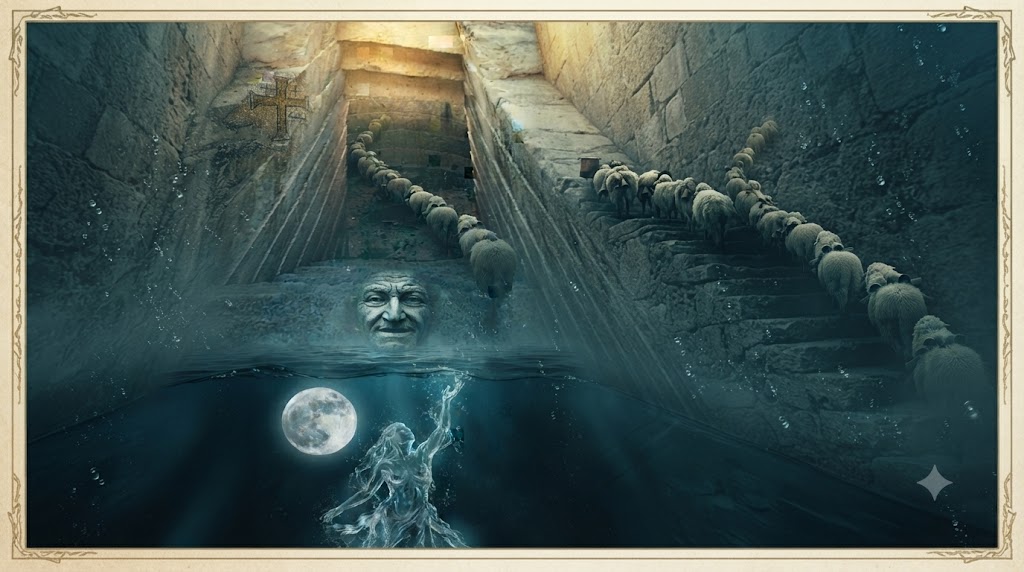
- Archeoastronomy: The geometry of sites like Santa Cristina highlights sophisticated astronomical skills, in which the moon or solar rays during equinoxes reflect directly mirroring in the deep waters of the well, binding the cult of the waters to lunar and solar cycles.
Synchretism and Christianity
With the advent of Christianity, the Catholic Church operated a systematic work of re-functionalization of old places of worship to eradicate paganism. Ancient sacred wells were renamed and associated with figures of saints or biblical episodes — such as the "Tres Res" well in Bosa linked to the Magi, or the Paulilatino well associated with Santa Cristina. However, under a formal Christian guise, traditional beliefs related to fertility, the purifying virtues of sources and agrarian rites continued to flow uninterrupted in Sardinian popular culture.
More Information about the Sacred Wells
- Olbia - Sa Testa: Presents seventeen steps and the source is still active. The first excavations date back to 1938, followed by important restorations that attest the frequenting of the site until Roman times, confirming the attachment of the Sardi to their beliefs despite the political and cultural dominations.
- Olbia - Cabu Abbas: Inside a monotor nuraghe a well was found in which it was found a statue (perhaps a goddess) with holes in the head, whose amphora of water recalls the anxieties related to fertility and fertility.
- Irru: The temple is free of access stairs and has a deep well over four meters, with canals that convey the water to a quadrangular vasque. It was frequented until medieval times.
- Villaputzu - Is Pirois: Situated in the Sarrabus and powered by an active source, it has the peculiarity of having a single-torre nuraghe built directly on the pseudocupola of the building.
- Sardara - Santa Anastasia: On the front of the temple are carved taurine protomes and breasts (emblems respectively of the Taurus God and the Mother God), symbols of fertility, life and health. The waters of the well were famous above all for the treatment of rheumatic pains and had a votive purpose.
Relations and Connections: The Case of Gârlo and Ballao
- Bulgarian-Sardinian comparison: The studies of the Bulgarian archaeologist Dimitrina Mitova Djonova (referred by the engineer from Cagliari Massimo Rassu) have highlighted the extraordinary resemblance between the sacred well of Gârlo (Bulgaria) and that of Funtana Croberta in Ballao (Sardegna).
- Historical and topical hypotheses: Djonova hypothesized Sardi's migration to Asia Minor, suffragated by toponyms as Sard and Sardis in Lidia, Serdi in Thrace, and the ancient name of Sofia (Serdika).
- Structural parallelisms: Sacred wells similar to the Sardinian ones were also found in different places of Greece (such as Zakros, Arckanes, Tirinto) and Crete.
The Hypothesis of a Cult of the Moon in Sardinia
- Symbology and cycles: The text explores the possible association between the Sardi and the worship of the moon, recalling the number of steps of many temples at wells ( thirteen, like the lunar months), the taurine protome and the moon that mirrors in the waters.
- Life and regeneration: Similarly to water, the moon grows, dies and is intimately connected to fertility (sea, rain, menstrual cycle). The symbolism of well water is combined with a rite of initiation: a regenerating bath that corresponds to healing or a new life.
The Protosarda Religion according to Raffaele Pettazzoni
- The supreme God and the sources: Pettazzoni defines protosarda religion as a shortened invocation towards a supreme and centralized deity (the Father of the lineage).
- Sardus Pater: Identified initially with indigenous figures and subsequently combined with the Phoenician/punic cult (Baal) or Roman, the Sardus Pater represents the figure of a primordial ancestor, a demiurgo that dispensed laws and ways of life, whose memory and attributes survived for a long time even in the Christian era (behind figures like Maimone or various saints).
Ordalic practices
- The judicial function: In the spaces adjacent to the temples at wells there were probably Orthodox practices (divine law to establish guilt or innocence through the water of the springs).
- Critical remarks: Scholars like Lanternari resize the practice by circumscribing it to warm and effervescent sources (such as the Bonorva Sansa Fountain).
Le Ordalie in Sardinia: The Divine Judgement and Water
In the traditional legal and cultural system, the ordalie (or judgments of God) represented evidence based on a fundamental principle: a normally harmful medium fails harmless to the harmless, or is harmful to the guilty. In Sardinia, the most widespread form of ordalia was linked towater.
- The proof of sight and contact: The eyes of the defendant reacted to contact with water, regardless of the level of effervescence or salinity; if water caused blindness or visual problems, the individual was found guilty by God.
- Theft of cattle and oaths: This practice was used especially for crimes against private property, especially for theft of livestock. As Solino wrote, whoever denied an oath a theft was forced to bathe his eyes with the waters of certain sources: if he said the truth saw better, if he was lying he suffered the punishment of blindness.
- Etymology and historical comments: The etymology of the word (urtheil, God's judgment) suggests a Germanic origin. John Cameroon remarked with irony that if the Sardinian sources had been used to irrigate the earth with the fear of such punishment, men would have avoided lies and despair.
- Post-Christian clandestineness: With the advent of Christianity the horde was banned. However, by not being able to carry out in public sacred wells, the practice continued in hidden places, far from indiscreet eyes, within ancestors like the cave "of devils" in Mount Arquerà in Seui, until the 16th-XVII century, before the institution of the Inquisition and the "mass consultations" decreed the end, although surviving in more difficult individual forms to pursue.
Human sacrifices and Foundation rituals
- The parricidium and the "sardonic Rice": The expression "Sardonic Rice" originates from a brutal Sardinian custom linked to the parricidium. It was often used to kill the old people over seventy years with rods and sticks, pushing them to the barracks where torrents flowed or sources were found, unclean to the divinities of water. The rite, accomplished by the children, was accompanied by inhuman laughter. This combines the tradition of a Sardinian lethal herb capable of contracting the facial muscles by simulating a smile, or the sacrifice of Carthaginian prisoners to Dionysus to invoke the rain.
From Ancient Divinity to Masks: The Mammuthones and the Divine Folly
With the formal abolition of human sacrifice, the victim's figure was replaced by simulac, animal or symbolic elements, while maintaining strong archaic value.
- The Maimone and the Mamuthones: The name of the ancient deity Corn survives in Mammuscone by Cozzone, in Mamuzones by Samugheo and Mamuthones by Mamoiada. In ancient times, the roles of torture or offering were sometimes entrusted to the "pazzi" or the marginalized of the village. In the ancient and Sardinian world the madness was not seen with bias, but as a form of divine investiture, making the bearers of such masks the subjects closer to the deity to propitiate rain and fertility.
- The ritual number: Mamuthones often appear in the number of twelve in Orgosolo, symbolizing a sacrificial victim for each month of the year, always in order to obtain rain and prosperity. In the extreme practices of Barbagia and Baronia, to fight drought, twelve skulls were taken from the ossuaries, being immersed in the water by the boys shouting "To proes or not proes? " (Do you want to rain or not rain? ).
Religious syncretism and Paganism Resistance in the Agro-Pastoral World
The passage from paganism to Christianity in Sardinia was not a linear break, but a long process of overlap and compromise.
- The compromise of the Church: Impossible to realize a true deep Christianization because of the scarcity of preparation of the low clergy — often complicity and participation of the popular superstitions —, the Church had to tolerate deviations and pagan rituals, hoping that time would separate "good wheat from the zizzania".
- The rural clergy and the anguishes of the land: The priests and the country friars lived the same anxieties as an agro-pastoral society crushed by the weather bizzes(siccity, nubifragi, lightning). Consequently, were the first to resort to magical-superstitious expedients, amulets, magic formulas and rites riding between Christianity and magic when official prayers failed.
- Sacred water and liturgical equivalence: The cult of pre-Christian waters found easy acceptance in the structures of the Christian liturgy, where baptismal, lustful and blessed water replaced the ancient ablutions. As effectively synthesized in the text recalling the words of Arcadu: "If we go to church we put our hand in a water tank. Nothing's changed. Water is sacred, it is the end and beginning of our existence (...). The sacred well was a church of other times with its protosarda water tank".
Criticism at the Myth of Isolation and Cultural Reprocessing
- The refutation of the millenary insulation: The myth of an isolated culture is finally discarded, waterproof to external contributions or little prone to change. On the contrary, the island is constituted as a lively crossroads in the heart of the Mediterranean, able to welcome and re-elaborate in an original way the contributions from numerous cultures.
Genesis and Evolution of the Divinities of the Sacred Wells
- From impersonal spirits to divine figures: Initially, the control of human waters and destinies was entrusted to impersonal entities or spirits.
- Oriental influences and local pantheon: Slowly, also thanks to oriental influences(with a leading role attributed to dionisiac worship), these forces were realized by taking defined names: Dionysus himself, Maimone, Iaccu, or the Sardus Pater and its manifestations.
- The persistence of thought patterns: The cognitive models and the logic of the religiosity of archaic Sardinia have not disappeared with antiquity, but have perpetuated over the centuries, rooting deeply and reaching to characterize and permeate even the Christianity of the successive centuries until the contemporary era.
The Relationship between the Church, Orthodoxy and Rural Plebi
- The "double meter" of orthodoxy: As highlighted by recalling the thought of Antonio Gramsci, the Church has often used a "double meter" to measure orthodoxy, to tolerate or not rigorously condemning the intellectual and moral deviations of the urban proletariat and the peasant to avoid losing the official faithful.