Abstract (IT): A journey into the millenary olive history of Sardinia, which has its roots in the prehistoric use of Nuragic lentisk oil to pass to Roman trade and the historical edicts of Spanish and Savoy. A path between biodiversity and oil tourism to discover the cultivar Bosana, rich in polyphenols, and ancient community traditions related to the collection.
Abstract: A journey into Sardinia's thousand-year-old olive growing history, rooted in the prehistoric use of lentisk oil by the Nuragic civilization, moving through Roman trade and historical edicts by the Spanish and the House of Savoy. An itinerary blending biodiversity and olive tourism to discover the high-polyphenol Bosana cultivar and the ancient community traditions tied to harvesting.
When we talk about extra virgin olive oil in Italy, the thought goes immediately to the hills of Tuscany or Puglia. Sardinia, however, preserves a millenary olive history that does not start in the cultivated fields, but among the wild bushes of the Mediterranean scrub and inside the large stone towers of the Bronze Age.
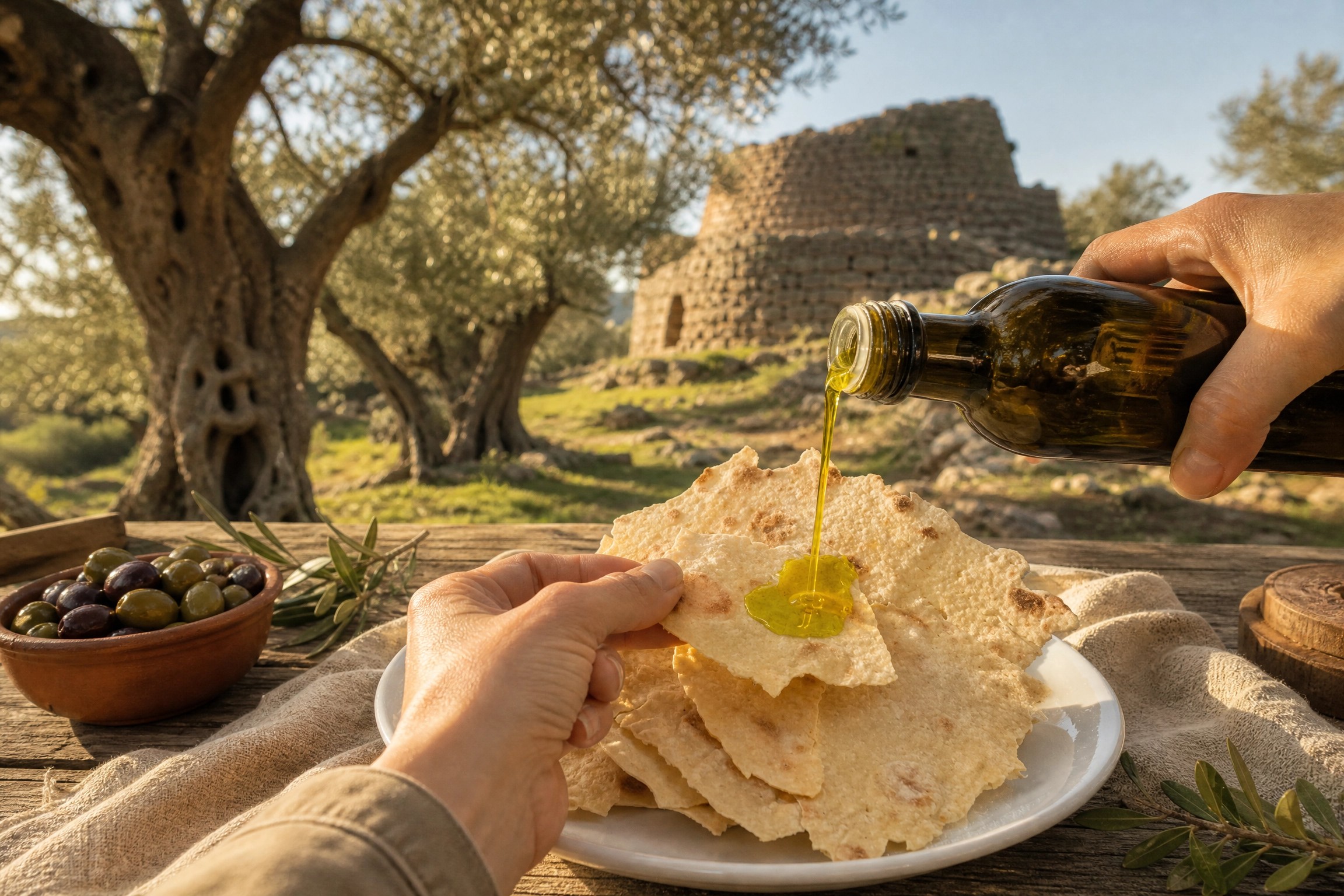
Today, oleotourism in the island allows to rediscover this link between archaeology, biodiversity and gastronomy.
Nuragici and the use of lentisk oil
Long before the domestic olive tree (Olea europaea L.) became the main culture of the island, the ancient sardinians used a spontaneous plant widespread in the territory: the lentil (Pistacia lentiscus).
The confirmation comes from the archaeological excavations conducted on the site of About Mulinu Mannu, at Terralba. Here archaeologists have found large quantities of carbonized lentisk seeds. The nuragic civilization extracted from the berries of this shrub a wild oil (ògliu de stincu) used for several purposes:
- Power supply: as condiment and vegetable fat of subsistence.
- Lighting: as a fuel for terracotta lizards inside the nuraghi.
- Medicine and rituals: as a healing ointment for the skin and funerary rites.
Only later, thanks to commercial contacts with Phoenicians, Carthaginians and Greeks, the techniques of grafting of wild olive were spread in Sardinia. In the museums of the island are exposed Greek ceramic vases (as ♪ and alabaster) testify to the importation of elite scented oils.
Roman trade and false medieval myth
During the Roman era, Sardinia's internal production was not enough to cover the needs of its inhabitants. Underwater archaeology has shown that the island depended on marine commercial routes: in the Sardinian seabeds the cargos of Roman ships filled with transport amphora from Betica (present-day Andalusia, Spain), the province that supplied the empire.
A common mistake in history books is the attribution to the medieval monks of the birth of Sardinian olive growing. Archive documentsAge of Judges they challenge this theory. The notary texts of the time indicate that the monks received as a gift from the Sardinians of the olive groves that were already implanted and grafted by local owners.
At that time, olive oil was still a luxury product, intended for noble canteens or religious sacraments. The people continued to use animal fats (lard and ostrich) or lentisk and olive oil. Not by chance Rural Code (XIV century) of Judge Mariano IV of Arborea, the laws protected vineyards and gardens, but the olive tree was barely mentioned.
From Spanish laws to the "Cavalieri" of the Savoy
The real expansion of olive growing in Sardinia is linked to precise political choices and edicts emanated between the 17th and the 19th centuries.
- Spanish obligation (1602): In order to exploit the productivity of the land, the Spanish administration imposes on every vessel the obligation to graft at least 10 wild olive trees per year. The laws to protect the fields were strict: those who damaged the trees risked prison or excommunication.
- Regio Editto sabaudo (1806): King Vittorio Emanuele I changed approach, choosing the path of economic and social incentive. To push the owners to plant trees rationally in the areas of Sassari, Alghero, Oristano, Bosa and Cuglieri, the State promised noble titles. Anyone who planted at least 4,000 cultivated olive trees received the official title of Knight. This led to a boom of plants and Sardinian oil began to be exported throughout the Mediterranean, even being required in Venice for the soap industry.
The cultivar Bosana and its properties
The geographical isolation of Sardinia has allowed the conservation of a unique heritage of biodiversity, with about 50 varieties of olive oil.
The most important and widespread variety is Bosana, native to the territory of Bosa but known in the island with different names:
- Sassarese or Round in the territory of Sassari.
- Aligaresa in the Alghero area.
- Palma in other places, because of the use of its branches during the processions of Palm Sunday.
- Pibireddu (peperoncino) in the municipality of Gergei, a name that recalls its characteristic spicy note.
From the scientific point of view, the oil from cultivar Bosana has a high content polyphenols and oleocantale, a natural antioxidant that possesses anti-inflammatory properties similar to those of ibuprofeno. The palate expresses a medium-intensive fruity, with net hints of artichoke, cardo and green almond, and a net balance between bitter and persistent spicy.
Anthropological aspect and oleoturismo today
Until the middle of the 20th century, the harvest of olives was a real community and social ritual, also described in the novels Grazia Deledda. The work in the fields combined the countries and provided for a clear division of roles: men dealt with the baking (glare) of the branches with long sticks, while the women collected the olives fallen on the ground, accompanying the days with traditional songs.
Today the old mills with granite mills driven by donkeys have been replaced by modern technological almazeres with cold extraction. This evolution allows to protect the properties of Bosana and other local varieties, transforming theoleoturismo in Sardinia in a complete cultural experience, able to combine the history of nuraghi to the well-being at the table.