Abstract (English)
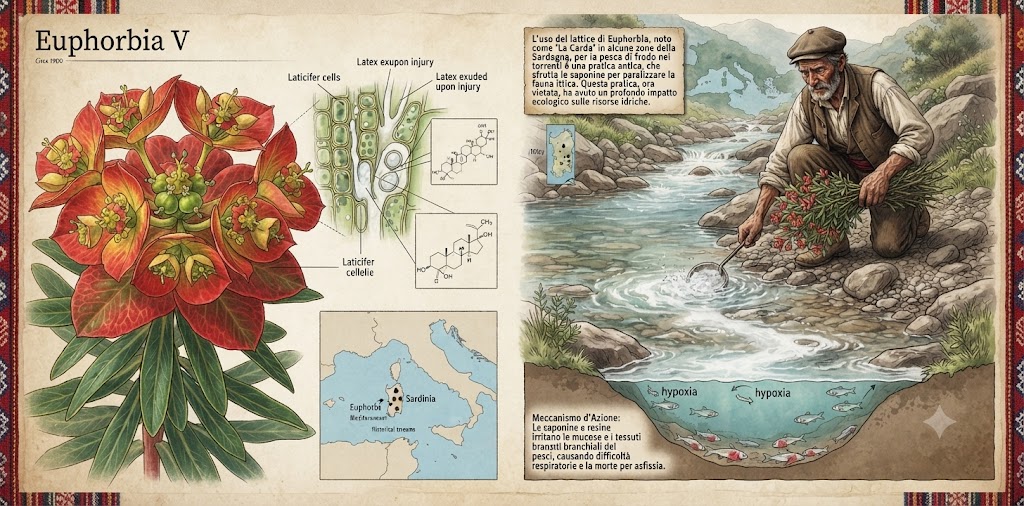
This article analyses the dual nature of the genus Euphorbia, typical and common plant of Sardinia focusing on the toxic power of its white latex and its historical use in the practices of frode fishing and poisoning of watercourses in the Mediterranean and Sardinian context. Through an ethnobotanic analysis, the mechanisms of ittiotoxic action of saponins and plant resins on mucous membranes and the respiratory system of fish fauna are examined. Traditional rural dynamics related to the exploitation of these substances in small basins and streams are also outlined, highlighting the profound ecological impact and the transformation of a botanical resource into an instrument of predation and environmental alteration.
Abstract (English)
This article examines the dual nature of the genus Euphorbia, focusing on the toxic power of its white latex and its historical use in illegal fishing practices and the poisoning of watercourses within the Mediterranean and Sardinian contexts. Through an ethnobota analysisnical, the ichthyotoxic mechanisms of saponins and plant resins on the mucous membranes and respiratory system of aquatic fauna are explored. The study also outlines traditional rural dynamics linked to the exploitation of these substances in small basins and streams, highlighting the elaborate ecological impact and the transformation of a botanical resource into an instrument of predation and environmental alteration.
The Dark Side of the Euforbiacee
Among the landscapes of the Mediterranean scrub and the arid garighe overlooking the coasts of Sardinia and the Mediterranean basin, the genus Euphorbia – and in particular theEuphorbia dendroides (arborescent euphobia or cypressin herb) andEuphorbia characias – brings with it a dual nature. On the one hand, these plants appear as sculptural and resilient elements of the native flora, able to resist the summer heat and to dye warm red shades with the arrival of spring; on the other, they guard a powerful and insidious chemical defense mechanism.
Inside their stems and their leaves flows a latex white, dense and viscous, rich in resins, saponins and diterpenic compounds (traditionally known as euforbone). This milky fluid, while having found limited and cautious uses in popular medicine – as an external caustic remedy for the removal of pores and warts – represents a formidable natural chemical weapon. Over the centuries, the stronghold Ittiotoxic action of this latex gave rise to external exploitation practices, mainly linked to marginal subsistence, fraud and alteration of watercourses.
Ittiotoxic Properties and Action Mechanism
The term ittiotoxic indicates the capacity of a toxic or lethal substance for fish. The latex of euphobias possesses biologically active molecules that, once placed in a confined aquatic environment, drastically interfere with the breathing and physiology of fish fauna.
When latex is dispersed in water, saponins and resins contained therein reduce surface tension and act as powerful irritants on mucous membranes and, above all, on branch offices fish. The immediate effect is a strong inflammation and the impairment of gaseous exchange: the fish quickly go into acute respiratory suffering (hypoxy), lose orientation, turn stunned or agonizing on the surface, making it so easily catchable to bare hands or with rudimentary networks by man.
Historical Practices of Water Courses and Frodo Fishing
In the ethnobotanic memory and in the rural chronicles of the Mediterranean, the use of such plants Euphorbia for illegal catch or fish subsistence is one of the most emblematic pages of criminal and peasant anthropology.
Frodo Fishing in Rivers and Torrents
In indoor and rural areas, especially in the periods of lean rivers and summer streams, bracconieri and frode fishermen used the reduced water flow to maximize the effectiveness of the vegetable poison. The traditional technique documented in different regions consisted of collecting large amounts of branches of Euphorbia dendroides or Euphorbia characias, beating them repeatedly inside bags or directly on the rock along the banks. The compound so grounded and intrigued of latex was placed in Gora, in the slow current pits or artificially disembarked sections of fresh water courses. The effect was rapid and devastating for the river ecosystem: not only the big fish (such as trout or sweet water sugars where present), but the entire aquatic fauna – including small crustaceans, poisons and insects – suffered a toxic collapse. The water was temporarily made sterile and impractical also for the absorption of cattle, which instinctively refused the liquid due to the acure smell and strong purgating and hemetic action of the residual poison.
Bonifiche e Usi Collaterali del Veleno
In addition to frode fishing, the caustic and irritating power of latex was historically used also for cleaning and "cleaning" of collection tanks, rural waterways and tanks invaded by leeches, insect larvae or aquatic pests infesting. Pouring the latex in the tanks meant killing each living organism inside them; however, this required a long period of waiting and rinsing before water could be again adapted to agricultural or zootechnical uses.
Geographical contexts and Local Traditions
Although the use of ittiotoxic plants (such as Verbasco or Euforbia) has been widely diffused throughout the Mediterranean basin – from the Iberian Peninsula to Greece, passing through South Italy and the major islands – Sardinia represents a territory where such practices have long been rooted in material culture due to the strong agro-pastoral isolation economy.
- The Sardinian rural contexts: In the areas of stain and calcareous gariga of Ogliastra, Campidano and Sassarese, where the arborescent euphobia (♪ or Lueddha in Sardinian language) thrives abundantly, knowledge of the toxicity of the plant was common heritage of the shepherds and local communities. Minor water courses, seasonal streams and small closed basins represented the most frequent theatres of these stocks in place at times of greater food need or of economic narrowness.
- Comparative scenes in the Mediterranean: Similar techniques were practiced in Liguria and other Tyrrhenian regions, where the coastal streams were occasionally treated with extracts of rupiculous euphobia to capture fish specimens destined for the local self-consumption.
Environmental impact assessment
The use of euphobia latex in wildlife fishing did not only constitute a violation of the laws on the protection of fish fauna, but it was a real ecological disaster on a local scale. Unlike selective instruments, plant saponins poisoning act indiscriminately:
- Biodiversity destruction: Each sensitive aquatic life was wiped out, compromising the trophic chain of the river or the water mirror concerned.
- Slow recovery: Minor water courses took years to restore a stable biological balance after the passage of similar toxic substances.
Today, the use of euphobia as an Italian agent belongs to a past of rural archaeology and of extreme subsistence, severely condemned by the environmental regulations in force on the protection of aquatic ecosystems. Nevertheless, retracing the history of these poisonings allows to understand the complex and ambivalent relationship that traditional communities have entertained with the spontaneous flora: a flora able to offer shelter, materials and remedies, but also to transform itself, through the refined chemistry of its juices, into a tool of predation and radical alteration of the natural environment.
Sardinia, terroir, Journeys
Chiara Gullo
GAE Tesserino: N°89, ASG1508
Notes to Piè di Pagina e Fonti
- Ethnobotanic and Local Nomenclature:
- Reference to traditional uses ofEuphorbia dendroides (note in Sardinian as ♪, Lueddha, runza de monte, milking, titimbaru) and other species present in the Mediterranean basin and in Sardinia.
- Source: Text of botany and Sardinian folk culture, descriptions of the medicinal and ethnobotanic properties of the Euforbiacee (cf. manuals of spontaneous flora and ethnic traditions of Sardinia).
- Ittiotoxic properties and Chemical Action:
- Study of diterpenic compounds, resins and saponins contained in latex, responsible for irritating action and the impairment of gill breathing of aquatic fauna.
- Source: Scientific literature on the toxicity of Euforbiacee and on the substances of vegetable origin historically employed in the grazing of fade.
- Anthropological and oral documentation on the poisoning of minor water courses and of Gora during summer periods for catching fish subsistence or fraud.
- Source: Archivio di etnostoria e anthropologia della Sardegna, memoria della cultura agro-pastorale etnostoria etnostoria etnostoria e anthropologia della Sardegna, memoirs of agro-pastorale and studies on the customs of illegal fishing in the island hinterland.